












Smoking & Gum Recession: Causes, Stages & Prevention Tips
Understanding gum recession from smoking is essential. Yes, smoking directly causes gum recession by reducing blood flow to gum tissue, suppressing your immune response, and accelerating bone loss around teeth. Nicotine constricts blood vessels, starving gums of the oxygen and nutrients they need to stay healthy. Receded gums do not grow back on their own, but quitting smoking halts further damage and makes professional treatments like gum grafting far more effective.
How Smoking Causes Gum Recession: The Exact Mechanism
Smoking triggers gum recession through three compounding pathways: vascular restriction, immune suppression, and oxygen deprivation, all operating simultaneously.
"Smoking is one of the most significant risk factors for the development and progression of periodontal disease. The chemicals in tobacco smoke impair the body's ability to fight infection and heal damaged tissue." — Dr. Joan Otomo-Corgel, Past President, American Academy of Periodontology
How Does Smoking Damage Gum Tissue and Bone?
Nicotine constricts blood vessels by up to 30%, cutting the flow of oxygen and nutrients to gum tissue. Starved of these inputs, gum cells cannot repair themselves or fight off bacterial infection, making nicotine-driven vascular restriction the primary driver of gum recession from smoking.
Carbon monoxide from cigarette smoke compounds this independently. It binds to hemoglobin more readily than oxygen does, reducing the blood's oxygen-carrying capacity even when vessel diameter isn't the limiting factor. The two mechanisms, nicotine constriction and carbon monoxide displacement, stack on top of each other.
Smoking also suppresses neutrophil and antibody activity, the immune system's first line of defense against bacterial plaque [2]. In non-smokers, plaque triggers a controlled inflammatory response that clears the infection. In smokers, that response is blunted and dysregulated, bacteria persist longer, and when inflammation does occur, it tends to be more destructive to the surrounding bone and connective tissue [3].
According to the CDC's Tips From Former Smokers campaign, smokers are twice as likely to develop periodontal disease as non-smokers, and four times more likely to develop advanced periodontitis [1]. That bone loss is what pulls the gum line down permanently.
What Are the Early Signs of Gum Recession from Smoking?
Tooth sensitivity, visible root exposure, and teeth that appear longer than they used to are the three most common early signs [2]. One signal that catches many smokers off guard: their gums bleed less than expected during brushing.
That reduced bleeding is not a sign of healthy gums. Nicotine constricts the blood vessels in gum tissue so tightly that the normal bleeding response is masked [3]. The infection is still progressing, you just can't see the usual warning sign. By the time visible recession appears, significant tissue and bone loss has typically already occurred.
How Gum Recession Progresses in Smokers: Stages from Early to Advanced Damage
Gum recession from smoking advances through four distinct stages, each measurably worse than the last, and smokers often miss the earliest warning signs entirely.
What Are the Stages of Gum Recession from Early Signs to Advanced Damage?
Stage 1, Gingivitis: The gum line reddens and swells as bacteria colonize below the surface. Most non-smokers catch this stage because their gums bleed when brushing [2]. Smokers frequently miss it, nicotine constricts blood vessels, suppressing that bleeding signal [3].
Stage 2, Early Periodontitis: Pockets of 4–5mm form between the teeth and gum tissue. Bone loss begins at this stage, and recession becomes visible, typically 1–2mm below the original gum line [2]. The damage is reversible with professional treatment, but most smokers still have no pain to prompt a dental visit.
Stage 3, Moderate Periodontitis: Pockets deepen beyond 6mm. Bone loss exceeds 30%, teeth may shift or loosen, and measurable recession reaches 3–4mm [3]. At this point, the structural support around the tooth root is compromised enough that standard cleaning alone cannot reverse the damage.
Stage 4, Severe Periodontitis: Bone loss surpasses 50% and recession can expose 5mm or more of root surface [3]. Teeth become mobile and are at serious risk of loss. Smokers are approximately twice as likely to reach this stage compared to non-smokers [1].
"Patients who smoke are far more likely to experience rapid attachment loss and deeper periodontal pockets than non-smokers. The masking of bleeding on probing makes early detection especially challenging in this population." — Dr. Kenneth Kornman, Editor-in-Chief, Journal of Periodontology
What Protective Measures Can Current Smokers Take to Minimize Gum Damage?
Quitting is the most effective intervention, but current smokers can slow progression with four concrete steps.
- Brush twice daily with a soft-bristle brush. Hard bristles accelerate mechanical recession on already-weakened gum tissue.
- Use chlorhexidine mouthwash. It reduces bacterial load in periodontal pockets where brushing cannot reach.
- Switch to 3-monthly dental cleanings. The standard 6-month schedule is inadequate for active smokers, quarterly professional scaling removes tartar buildup before pockets deepen further [1].
- Supplement with vitamin C. Smoking depletes vitamin C, which the body needs to synthesize collagen in gum tissue. Restoring adequate levels supports tissue repair between dental visits.
Can Receding Gums Grow Back After You Quit Smoking?
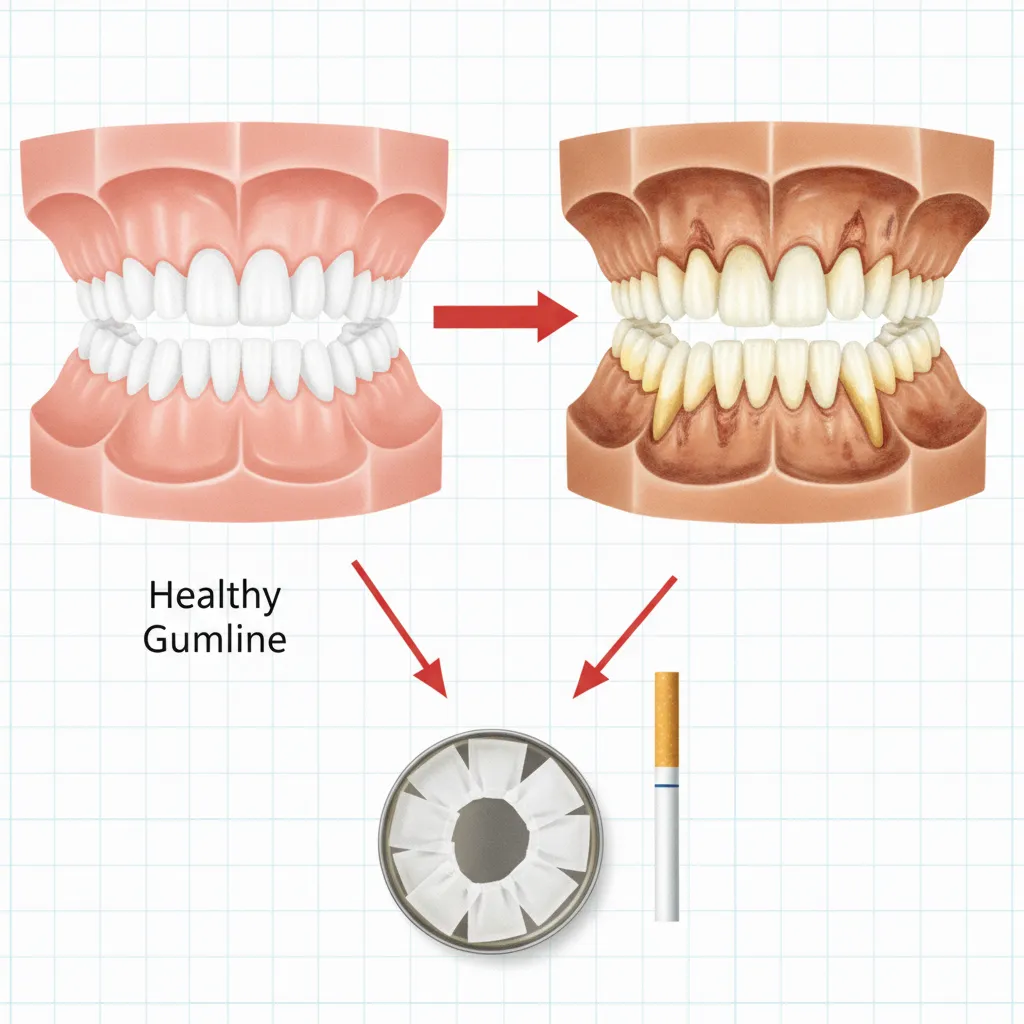
Quitting smoking halts gum recession but does not reverse it, lost gum tissue cannot regenerate without surgical intervention.
Can You Reverse Gum Recession or Just Halt It from Getting Worse?
Gum tissue that has already pulled back from the tooth does not grow back on its own. This is true whether the cause is gum recession from smoking, aggressive brushing, or untreated periodontitis, once the tissue is gone, it stays gone without a procedure like a gum graft.
What quitting does change is the rate of destruction. Blood flow to gum tissue begins recovering within 2–4 weeks of stopping smoking, and immune function, which smoking actively suppresses, normalizes within 6–12 months. That means your body can finally mount a proper defense against the bacteria driving further recession.
Surgical options such as connective tissue grafts can restore lost gum coverage, but they work best on a stable, non-smoking baseline. Attempting grafts while still smoking significantly increases failure rates, which is why most periodontists require cessation before scheduling the procedure.
What Timeline Should You Expect for Gum Recovery After Quitting?
Recovery follows a predictable sequence once you stop smoking:
- Weeks 2–8: Gum inflammation begins to reduce. Bleeding on brushing decreases as blood flow normalizes.
- Months 3–6: Measurable improvement in gum pocket depth becomes detectable at dental check-ups.
- Month 12: Full stabilization. One study found that pocket depth and bone loss progression in ex-smokers slowed to near non-smoker rates after 11 years of cessation [3].
The 12-month mark is the critical threshold, periodontal disease risk drops significantly within the first year after quitting [2]. Recession already present won't disappear, but the damage stops compounding. Former smokers who maintain consistent dental hygiene and attend regular professional cleanings can expect their gum health to stabilize at levels approaching those of non-smokers over time.
If you're considering nicotine pouches as a quit-smoking tool and want to understand their own impact on gum tissue, the site's Nicotine Pouch Gum Recession: Causes & Recovery article covers that distinction in detail.
Treatment Options for Gum Recession from Smoking
Gum recession from smoking is treated through a tiered approach, from deep cleaning to surgical grafting, matched to how far the tissue has already pulled back.
What Dental Procedures Can Fix Receding Gums Caused by Smoking?
Scaling and root planing is the first professional step for smokers with periodontal pockets of 4mm or more [2]. The procedure removes hardened tartar below the gum line and smooths root surfaces so bacteria have less to grip onto. It doesn't reverse recession, but it stops the damage from accelerating.
For recession of 2mm or more, a connective tissue graft (CTG) is the standard surgical fix. A dentist harvests a small strip of tissue from the palate and sutures it over the exposed root. Success rates exceed 90% in non-smokers, but drop to 60–70% in active smokers, because nicotine restricts blood flow and slows healing. Quitting before surgery isn't optional advice; it directly determines whether the graft survives.
The Pinhole Surgical Technique (PST) is a less invasive option for mild-to-moderate recession. Rather than harvesting donor tissue, the surgeon repositions existing gum tissue through a small puncture hole. Recovery is faster, but it isn't appropriate for severe cases where significant tissue volume has already been lost.
"Tobacco cessation is the single most important step a patient can take before undergoing any periodontal surgical procedure. Smoking compromises blood supply to the surgical site and dramatically increases the risk of graft failure and post-operative infection." — Dr. Michael McDevitt, Board-Certified Periodontist, University of North Carolina School of Dentistry
When Do You Need Professional Treatment Versus Home Care?
Home care slows progression but doesn't reverse recession that has already occurred. Use a soft-bristle or electric toothbrush, a non-abrasive toothpaste with stannous fluoride, and a prescription-strength fluoride gel on exposed root surfaces to reduce sensitivity and decay risk.
See a dentist if recession exceeds 1mm, if tooth sensitivity disrupts eating or drinking, or if you can see exposed root surface [3]. Don't wait for pain, smoking suppresses the gum's inflammatory response [1], which means by the time it hurts, the damage is already significant.
Which Smoking Methods Damage Your Gums the Most?
Cigarettes cause the most severe gum damage, but every nicotine delivery method that contacts oral tissue or restricts blood flow harms your gums to some degree.
How Does Gum Recession Differ Between Cigarettes, Vaping, and Smokeless Tobacco?
Cigarettes sit at the top of the harm hierarchy. The combination of nicotine, carbon monoxide, and over 7,000 chemical compounds suppresses immune response, starves gum tissue of oxygen, and accelerates bone loss. Smokers are 2–3 times more likely to develop severe periodontitis than non-smokers [2], making gum recession from smoking the most well-documented oral health consequence of the habit.
Smokeless tobacco (chew, dip, or snus) causes a different pattern of damage: localized recession concentrated at the exact site where the product sits against the gum. Measurable recession of 1–2mm can appear within two years of regular use [3], and because the damage is focal rather than generalized, it often goes unnoticed until the tissue loss is significant.
Vaping appears less destructive than cigarettes in current research, but it is not harmless. Nicotine still constricts blood vessels and reduces gum perfusion, while propylene glycol dries oral tissue and disrupts the mucosal barrier. A 2021 study found vapers had significantly higher rates of gum inflammation than non-users, a direct precursor to recession.
No method clears the bar for gum safety. If you're looking for nicotine alternatives that remove tobacco and combustion from the equation entirely, the guides on clean alternatives to smoking and best tobacco-free alternatives for 2026 cover options that don't place chemically loaded material directly against your gum tissue.
Frequently Asked Questions
How quickly does smoking cause gum recession?
Gum recession from smoking can begin within a few years of regular tobacco use, though the timeline varies by frequency and individual biology. Smoking suppresses the immune response and reduces blood flow to gum tissue [2], which accelerates the progression of gingivitis into periodontitis. Heavy smokers, those consuming a pack or more daily, tend to show measurable recession faster than light smokers. Some studies note clinically visible recession in smokers within 3–5 years of habitual use, though early-stage damage often goes unnoticed without a dental exam.
Does quitting smoking stop gum recession immediately?
Quitting smoking halts the primary driver of recession, but it does not reverse damage that has already occurred. Once gum tissue pulls back from the tooth, it does not regenerate on its own [3]. What quitting does do is allow your immune system to recover and your gums to respond to treatment, meaning dental interventions like scaling, root planing, or grafting become significantly more effective after you stop smoking [1].
Can a dentist tell if you smoke by looking at your gums?
Yes, dentists can identify signs of smoking through several visible oral markers. Stained teeth, reduced gum bleeding (a paradoxical effect of smoking masking inflammation) [2], thickened or pale gum tissue, and bone loss patterns visible on X-rays all point to tobacco use. Experienced periodontists often flag smokers before patients disclose their habit, precisely because the gum presentation is distinct from recession caused by brushing too hard or hormonal changes.
Is gum recession from smoking covered by dental insurance?
Coverage depends on your specific plan, but most standard dental insurance policies cover periodontal treatment, including scaling and root planing, at least partially, regardless of cause. Gum grafts, which address advanced recession, are more variable: some insurers classify them as restorative, others as cosmetic. Disclosing tobacco use is required on most dental intake forms, but it typically affects treatment recommendations rather than claim eligibility.
Does smoking affect how well gum disease treatments work?
Yes, significantly. According to the CDC's periodontal disease overview, smokers respond less favorably to all forms of periodontal treatment compared to non-smokers. Scaling and root planing produces shallower pocket reduction in active smokers, and surgical graft success rates drop considerably. Nicotine impairs blood supply to healing tissue and blunts the immune response needed for post-treatment recovery. Quitting before treatment begins is strongly recommended by periodontists to improve outcomes and reduce the risk of recurrence.





Conclusion
Smoking doesn't just stain your teeth, it systematically dismantles the tissue and bone that hold them in place [1]. The three mechanisms that drive this, reduced blood flow, immune suppression, and chronic bacterial overgrowth, work simultaneously, which is why smokers are up to seven times more likely to develop severe gum disease than non-smokers [2].
Two actions matter most: stop exposing your gums to tobacco smoke, and see a periodontist for a baseline assessment before recession advances to bone loss. If you're using nicotine pouches as a bridge away from cigarettes, check that your chosen product is tobacco-free, Outdare's Clean Nicotine pouches contain no tobacco leaf, removing one direct irritant from the equation while you work through the reduction process.
Book a periodontal screening this month. Early-stage recession is treatable. Advanced bone loss is not.
Sources & References
- Smoking, Gum Disease, and Tooth Loss | Overviews of Diseases/Conditions | Tips From Former Smokers | CDC
- Can Smoking Cause Receding Gums?, Blossom River Dental San Jose California
- Does smoking cause receding gums?, NiQuitin UK
Recommended Articles
Explore more from our content library: